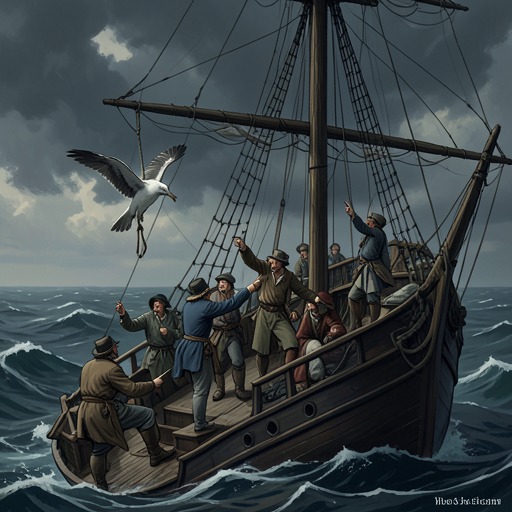
Love for all living things
The Rime of the Ancient MarinerLove for all living things is the poem’s central ethical principle, but it becomes more than a lesson stated at the end: it is the change in perception through which the Ancient Mariner can pray again. After isolation and suffering have severed him from ordinary human and spiritual fellowship, he sees the water-snakes as living beings whose beauty deserves love in its own right. His blessing is unplanned, and its immediate consequence is both inward and outward: prayer returns, and the albatross sinks from his neck. The concluding counsel then gives that moment a universal form, joining love of creatures to love of God.
From estrangement to attention
The poem places this change against a sequence of alienation from the natural world. The voyage begins with the ship cheered out of the harbour, but the Storm-Blast drives it southward into mist, snow, and mast-high ice. Ice surrounds the vessel, cracking and roaring until the helmsman finds a way through; afterward, a good south wind rises behind the ship and the Albatross follows. These changes make the nonhuman world a force that can endanger, assist, and accompany human beings, rather than mere scenery for their voyage.
Yet the Mariner’s relation to the world is not healed simply because the ship escapes the ice. In a later stillness, the Sun hangs over the mast in a hot, copper-coloured sky, and the crew speak only to break the sea’s silence. After the Mariner’s isolation becomes absolute, he is alone on the wide sea beneath the moving Moon. The contrast between immense surroundings and a solitary human observer prepares the encounter with the water-snakes: attention to other life interrupts a condition in which the Mariner can neither find companionship nor pray.
The water-snakes and the return of prayer
Beyond the ship’s shadow, the Mariner watches the water-snakes move through the water. Their tracks shine white; as they coil and swim, each track flashes like golden fire. The scene gives them their own visible movement and beauty before it records what the Mariner makes of them. His response begins as affection, described as a spring of love gushing from his heart, and becomes a blessing he gives without conscious design.
The order of events matters. The Mariner does not first pray in order to earn release or deliberately bless the creatures as a bargain. He blesses them unaware; in that same moment he can pray again. The albatross then falls from his neck and sinks into the sea. The physical burden associated with his estrangement is removed only after his unforced recognition of the water-snakes’ worth. The episode makes restored prayer inseparable from an affectionate regard for living beings, rather than from an assertion of human mastery over them.
A principle extended to every creature
At the close, the Mariner turns from recounting his experience to address the Wedding-Guest. His farewell introduces the teaching that one prays well by loving, and best by loving all things, great and small. The final explanation grounds that breadth in divine creation: God made and loves all. Love is therefore not restricted to beings useful to people, familiar to them, or conventionally celebrated; the poem’s stated rule refuses to rank creatures by size or human importance.
The conclusion also reaches beyond the Mariner’s solitary encounter. Its catalogue of old men, infants, loving friends, youths, and maidens places human community beside the explicit inclusion of bird and beast. The movement is from one vivid act of attention to a general ethic: the water-snakes first appear as particular, beautiful lives, and the closing counsel insists that love must extend across creation. The poem does not replace the Mariner’s punishment with an easy absolution. Instead, it presents his recovered capacity to love and pray as a lasting lesson he must carry to others.
Narrative and ethical significance
The episode gives the poem’s moral teaching a concrete cause and consequence. The water-snakes are not only an abstract emblem: their luminous tracks and independent movement hold the Mariner’s attention, and his spontaneous blessing marks a real change in how he responds to nonhuman life. At the same time, the scene alters his spiritual condition, restoring prayer and coinciding with the albatross’s fall. The ethical and narrative turns are thus bound together in a single act of perception and feeling.
This relationship also shapes the poem’s treatment of the natural world. Ice, wind, Sun, Moon, and sea exert powers that exceed the human crew’s control; the water-snakes, in turn, are encountered as living presences rather than objects of use. The closing rule makes explicit the implication carried by that encounter: reverence cannot stop at human fellowship. The Wedding-Guest receives the Mariner’s account as an instruction in love that joins person, bird, and beast under a shared divine creation.